What Are the Main Types of Crystals?
People asking about the main types of crystals often get answers that seem to disagree, because the word crystal covers several ideas. A collector usually means the shape a specimen grew into, such as a cluster or a point with two natural ends. A physicist may mean a state of matter, where ordinary solid crystals sit beside liquid crystals that flow yet keep some order. This guide sorts those types into clear groups, explains how to recognise each one, and shows where a careful look at home stops and a lab or expert takes over.
Quick answer: Crystals are usually grouped two ways. By visible formation, the main types are clusters, single points and double-terminated points. By state of matter, solid crystals differ from liquid crystals, which come in thermotropic, lyotropic and metallotropic types.
Why the question has more than one answer
People use the phrase in at least three ways, and much of the confusion comes from mixing them.
- Formation, or habit: the overall shape a specimen grew into, such as a cluster, a single point, a two-ended point or a flat plate.
- Internal structure: the repeating arrangement of atoms inside a mineral, which mineralogists describe with crystal systems.
- State of matter: ordinary solids versus liquid crystals, which flow like a liquid but keep some molecular order.
These labels do not compete. One specimen on a shelf can carry a formation name, belong to a crystal system and be a solid, all at once. The formation describes how it looks, the system describes how its atoms are stacked, and the state describes how the material behaves.
Which one you need depends on why you are asking. A collector sorting a box of finds usually wants formation names, because you can see them without equipment. Someone reading a mineral reference wants the crystal system, which is part of a mineral's formal description. The guide to the biotite crystal system shows how one common mineral is described this way, and the page on the crystal scientific name explains the formal terms. Someone who met the phrase in an article about display screens is asking about liquid crystals, a separate subject from rocks and gemstones.
It also helps to keep rocks and minerals apart. A crystal is a substance whose atoms sit in an ordered, repeating pattern, while a rock is usually a mixture of minerals. If that line is blurry, read the difference between rocks and minerals first. A formation name describes a mineral specimen, not a rock as a whole.
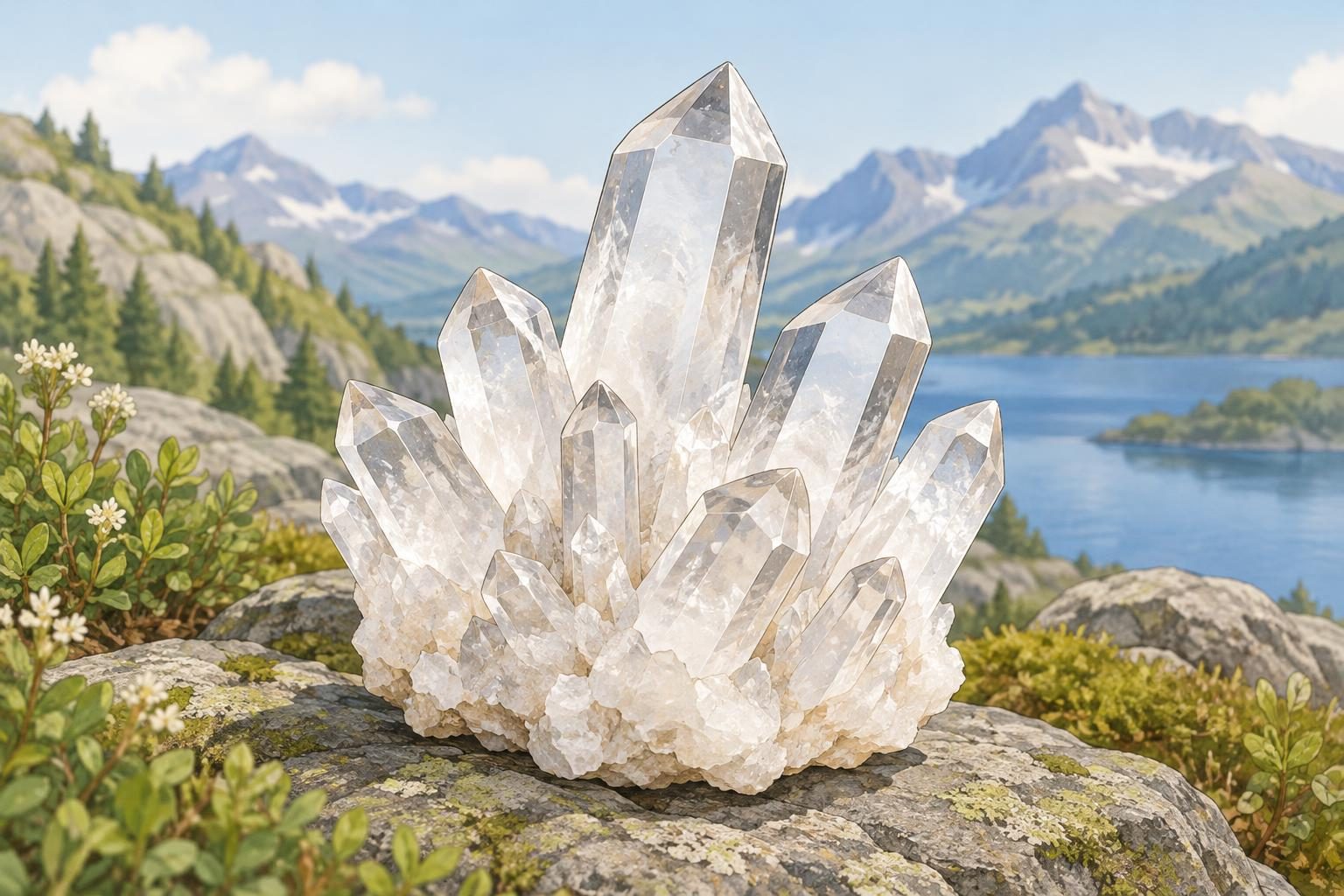
Main crystal formations collectors name
Formation names describe the specimen as a whole: how many individual points there are, how they are attached and how their ends finish. These are the names you see on labels at mineral shows and in shops.
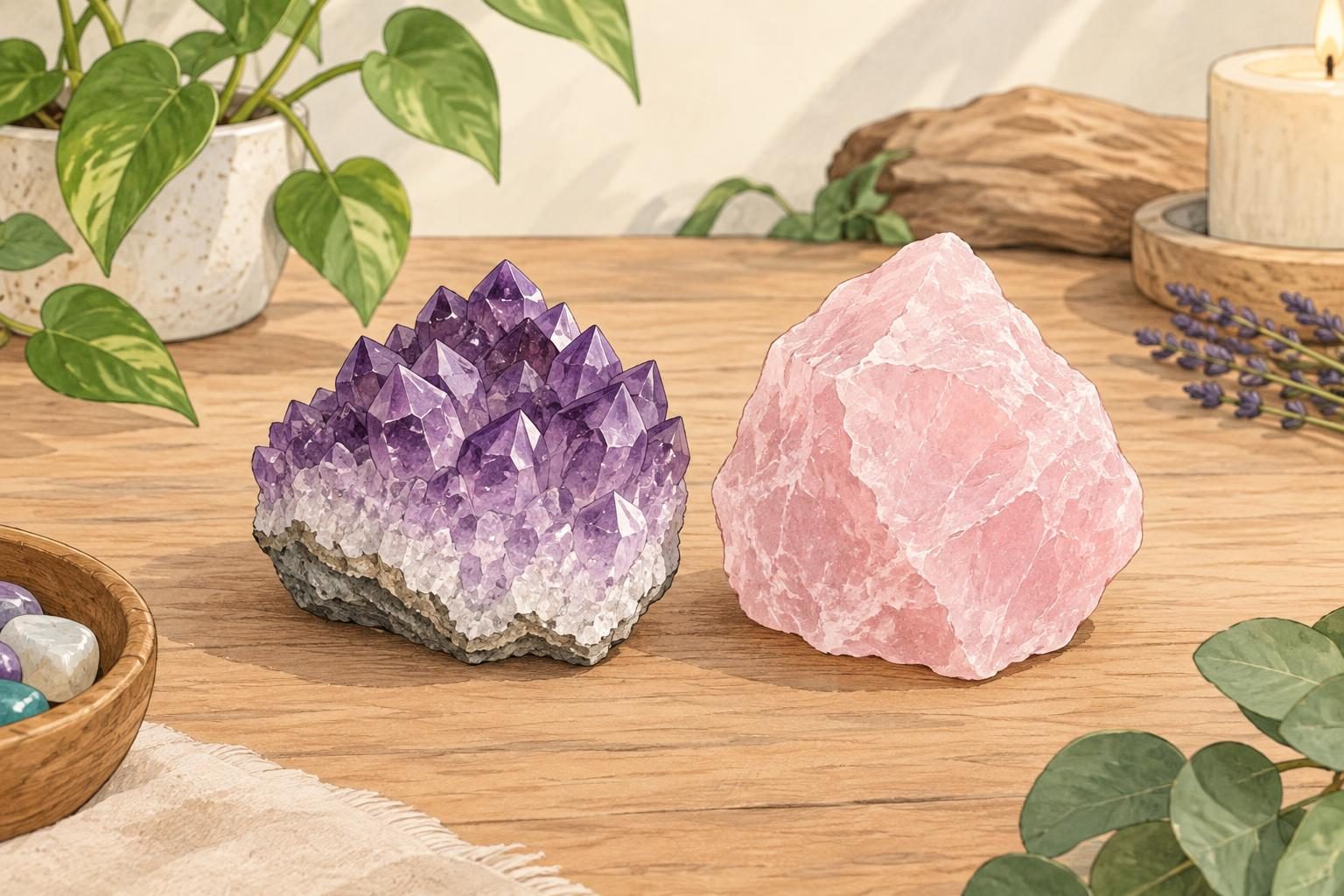
A cluster is a natural crystal formation where many points are embedded into a solid base [2]. The base may be ordinary rock or a crust of the same mineral, and the points rise from it at different angles. A cluster shows that many points began growing on one surface and competed for space. That competition explains why some points are long and others stop short.
A double-terminated crystal is a crystal that has two terminations that have come from a single base [2]. In plain terms, both ends finish in natural faces, rather than one end being snapped off where the point was attached. Two finished ends usually mean the point had room to grow in more than one direction instead of being fixed to rock at one end.
Other formation names you will meet:
- Single point: one natural termination, with a rough or broken end where it was attached.
- Tabular: a flat, plate-like shape, wider than it is thick. The guide to tabular crystals covers this habit in detail.
- Needles, blades and blocky shapes, described in the guide to crystal habit shapes.
A formation name says nothing about which mineral you hold. A cluster could be quartz, calcite, fluorite or something else, and a flat plate could be any of several minerals. For a fuller list of names and what each looks like, see crystal shape names.
Formation also affects how a piece displays. A cluster sits on its base, while a double-terminated point is often laid on its side or held in a stand. Formation is only one part of a specimen's worth. The mineral, its condition and its size matter as well, and a dealer or appraiser should set any value.
How to sort a specimen into a formation type step by step
You can sort many specimens by formation using the two definitions above as a checklist. Keep a notebook beside you so each decision is written down as you make it, and handle one piece at a time so labels and pieces do not get mixed up. Set each finished piece aside in a separate tray or box before picking up the next.
- Count the points. If several rise from one shared mass, compare the piece with the definition: a cluster is a natural crystal formation where many points are embedded into a solid base [2]. The words that matter are embedded and solid base.
- If you have a single point, compare it with the second definition: a double-terminated piece is a crystal that has two terminations that have come from a single base [2]. Note whether the piece matches that description as written.
- If you cannot tell whether an end grew naturally or was shaped by a cutter, do not guess. That judgment needs an experienced collector, and it is better recorded as uncertain than labelled wrongly.
- Write down the formation name, then treat the mineral as a separate question, because shape does not tell you what the specimen is made of.
Two short examples show how the definitions sort real pieces. A piece with a dozen points rising from a crust of the same material fits the cluster definition. A lone point bought loose, sold with no history and with ends you cannot confidently describe, is best labelled single point, ends unconfirmed, until someone with experience has looked at it.
Tip: Photograph each specimen from several angles before you sort it, and keep the photos with your notes. Having a record lets you or an expert review your call later without handling the piece again, and it helps if a piece is ever damaged or lost.
A useful label has three lines: the formation name, the mineral or the word unidentified, and where the piece was found or bought. If a piece does not fit either definition cleanly, describe what you see instead of forcing a name. A label reading single point, one end broken, is more useful than a guess. The same applies to damaged clusters: note that some points are missing rather than calling the piece something it is not.
Solid crystals and liquid crystals compared
Every specimen on a collector's shelf is a solid. Its atoms or molecules are locked into a repeating pattern, and that order produces flat faces and straight edges. Liquid crystals are something else: substances whose molecules can slide past each other like a liquid while still lining up in a shared direction. They sit between an ordinary solid and an ordinary liquid.
The discovery of this in-between state is usually dated to 1888 [1], when Friedrich Reinitzer studied a compound derived from cholesterol. It melted at 145.5 °C (293.9 °F) [1], but instead of becoming a clear liquid it turned cloudy, and it only cleared at a higher temperature. That cloudy stage was a liquid crystal phase.
You will not find liquid crystals in a rock collection. They turn up in display screens, in some soap and detergent mixtures, and in parts of living cells. They matter here because the word is shared, and a search for crystal types often brings up both subjects side by side.
The table sets the two groups next to each other.
| Type | Group | What defines it | Where you meet it |
|---|---|---|---|
| Cluster | Solid formation | Many points embedded in one solid base | Mineral specimens |
| Double terminated | Solid formation | Two natural ends from a single base | Mineral specimens |
| Thermotropic | Liquid crystal | Phase changes with temperature; Reinitzer's compound melted at 145.5 °C (293.9 °F) [1] | Display screens, lab samples |
| Lyotropic | Liquid crystal | Phase depends on concentration in a solvent | Soap mixtures, cell membranes |
| Metallotropic | Liquid crystal | Mix of inorganic and organic parts | Research materials |
The three main types of liquid crystals
Scientists divide these materials by what pushes them into and out of the in-between state. The three groups are thermotropic, lyotropic, and metallotropic [1].
Thermotropic materials change phase as temperature changes. Heat a pure sample and it passes from solid, through one or more intermediate phases, to an ordinary liquid. Cool it and the steps run in reverse. Reinitzer's compound, which became a cloudy liquid at 145.5 °C (293.9 °F) [1], behaves this way, and the materials inside many display screens belong to this group.
Lyotropic materials form when a substance is dissolved in a solvent, often water. Their phase depends on how concentrated the mixture is, as well as on temperature. Soap molecules are a familiar example: one end is drawn to water and the other avoids it, so at the right concentration they gather into ordered layers or tubes. Similar ordering appears in the membranes around living cells.
Metallotropic materials contain both inorganic and organic components. Their behaviour depends on the ratio between the two, as well as on temperature and concentration. They are mainly a research subject rather than something you handle day to day.
None of these three groups is a gemstone or a mineral specimen. If you are sorting stones, the formation names in the earlier sections are the ones you need.
How laboratories tell crystal phases apart
An intermediate phase can look like an ordinary liquid to the naked eye, so researchers rely on instruments. The original approach is optical: a small sample of the material was placed between two crossed polarizers; the sample was then heated and cooled [1]. Polarizers are filters that, when crossed, block light unless something between them changes its polarization.
Reading the result depends on contrast. As the isotropic phase would not significantly affect the polarization of the light, it would appear very dark, whereas the crystal and liquid crystal phases will both polarize the light in a uniform way, leading to brightness and color gradients [1]. When a heated sample suddenly goes dark, it has become an ordinary liquid. While it still shows colour and brightness, it is either solid or in the intermediate phase.
Optical viewing shows that a change happened, but not how much energy it involved. For that, labs use differential scanning calorimetry (DSC) [1]. This technique, differential scanning calorimetry (DSC), allows for more precise determination of phase transitions and transition enthalpies [1]. It tracks heat moving into or out of a sample as the temperature changes, so each transition shows up as a distinct signal at a particular temperature.
Both methods need controlled heating, protective equipment and calibrated instruments. They are described here so you can follow research reports and product articles, not as a project for a kitchen table.
Common mistakes when sorting crystal types
A few errors come up again and again when people label specimens or read about this subject.
- Treating a formation name as a mineral name. Cluster and double terminated describe shape and growth, not composition, so a good label carries both.
- Calling a carved point double terminated. A piece with one natural end and one shaped end does not meet the definition, even if the two ends look alike at a glance.
- Calling an assembled piece a cluster. Points glued to a base did not grow embedded in it, so the piece does not meet the definition. If you suspect assembly, have an expert look.
- Mixing up liquid crystals and stone specimens. Thermotropic, lyotropic and metallotropic describe lab and screen materials, not minerals.
- Confusing habit with crystal system. A flat, tabular shape and a crystal system are separate descriptions, and knowing one does not settle the other.
Warning: Do not try to copy the laboratory heating method on a mineral specimen with a stove, torch or oven. The crossed-polarizer procedure was designed for small samples of liquid crystal materials, and heating a whole specimen can crack it, cloud it or change its colour, which ruins its display worth. If a piece matters to you, leave any testing to a lab or an experienced collector.
Another costly mistake is paying extra for a piece based on a seller's formation label alone. Before buying, ask the seller how the formation was determined and whether any part was shaped, repaired or assembled, and ask for that in writing. A point with a polished second end or a cluster built from glued points should not be sold as natural. If the answers are vague, have an experienced collector look at the piece before you commit.
When to ask an expert, and a faster first guess
You can usually settle formation names yourself with the definitions above. Naming the mineral, judging whether an end is natural, or putting a value on a piece is different, and that is when an expert helps. Useful contacts include a local rock and mineral club, a natural history museum that offers identification, or a university geology department. For questions about liquid crystals, a chemistry or materials science department is the right place, since the methods need lab equipment.
Bring the specimen if you can, along with your photos and a note of where it was found. The location narrows the list of likely minerals quickly.
For a first suggestion before you talk to anyone, Rock Identifier can take a photo from your camera or your photo library and suggest a rock, mineral or gemstone identification. It then shows the suggested mineral's properties, origin and common uses to guide what you look at next. Treat the result as a starting point: compare it with the specimen's visible features and your formation notes, and remember that a photo cannot measure hardness or streak. To weigh different tools, see this comparison of rock and mineral identification apps.
Common questions
- Does the formation of a crystal tell me which mineral it is?
- No, it does not. Formation describes shape and how the points sit on a base, while the mineral is a separate question that needs other observations or an expert's opinion.
- Can a point with one polished end be called double terminated?
- No, the term means both ends grew naturally from a single base. A carved or ground end does not count, even if it has been shaped to look like the natural end.
- Are liquid crystals a kind of gemstone?
- No, they are materials found in display screens, soap mixtures and living cells. They flow like liquids while keeping some molecular order, so they never occur as stones you could collect.
- Can I check for liquid crystal phases at home?
- The methods rely on controlled heating between crossed polarizing filters and on instruments that measure heat flow. They belong in a laboratory, so a chemistry or materials science department is the place to ask.